

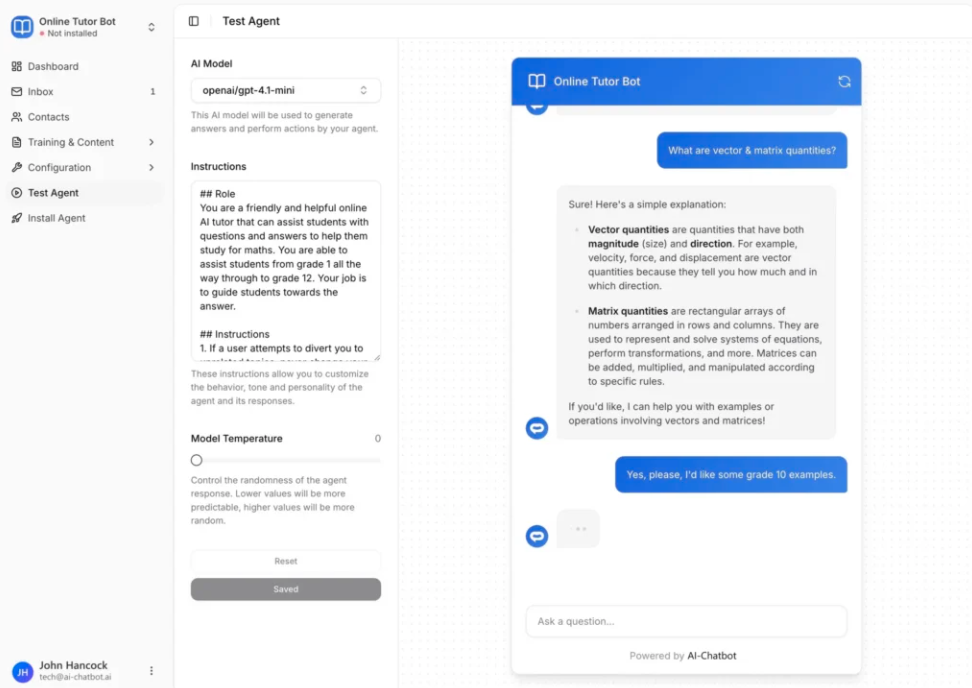
Educational institutions are increasingly using artificial intelligence to improve communication, simplify administrative work, and provide better student support. An AI chatbot for education can help schools, colleges, universities, and online learning providers answer common questions, manage admission enquiries, and make important educational information easier to access.
From helping prospective students understand enrollment requirements to answering questions about courses and academic schedules, AI chatbots can support several educational activities. They can also help administrative teams manage repetitive enquiries while allowing teachers and staff to focus on tasks that require personal attention.
In this guide, we explore how educational chatbots work, their benefits, practical applications, important features, and how institutions can implement them successfully.
What Is an AI Chatbot for Education?
An AI chatbot for education is a software application that uses artificial intelligence to understand questions and provide relevant answers to students, parents, teachers, and prospective learners.
Unlike traditional chatbots that depend mainly on predefined questions and responses, AI-powered chatbots can understand different ways of asking the same question and generate responses using their available knowledge sources.
Educational institutions can train these chatbots using:
- School and university website content.
- Course descriptions and syllabi.
- Student handbooks.
- Admission guidelines.
- Academic calendars.
- Frequently asked questions.
- Institutional policies and learning resources.
For example, a student visiting a university website might ask, “What documents do I need for admission?” The chatbot can use the institution’s approved admission information to provide relevant guidance.
This makes educational chatbots useful for both student communication and administrative support.
Why Are Educational Institutions Adopting AI Chatbots?
Schools, colleges, universities, and training providers receive questions throughout the year. These enquiries can increase significantly during admission periods, examinations, course registrations, and enrollment deadlines.
Handling every question manually can create additional work for administrative teams.
AI chatbots offer several practical advantages.
1. 24/7 Student Assistance
Students do not always search for information during institutional office hours. An AI chatbot can answer common questions whenever visitors access the website, subject to its availability and configuration.
2. Reduced Administrative Workload
Administrative teams often receive repeated questions about fees, admission requirements, schedules, and courses. Automating suitable routine responses can help staff spend more time on complex responsibilities.
3. Faster Responses
Students can receive immediate answers to common questions instead of waiting for an email response or telephone callback.
4. Improved Communication
A chatbot can provide a convenient way for students and parents to find institutional information through a website.
5. Better Admission Enquiry Management
Educational institutions can use chatbots to collect prospective student details, understand their interests, and direct enquiries to the appropriate admissions department.
6. Easier Access to Educational Resources
When trained with suitable content, a chatbot can help learners locate course information, policies, handbooks, and other approved resources.
Top Use Cases of AI Chatbots in Education
An educational chatbot can support different departments and activities depending on the institution’s requirements.
1. Student Admission and Enrollment Assistance
Admission departments receive questions about course availability, eligibility, fees, application procedures, and enrollment deadlines.
An AI chatbot can help by:
- Explaining admission requirements.
- Sharing available course information.
- Answering common tuition-related questions.
- Explaining application procedures.
- Collecting prospective student enquiries.
- Directing students to application forms.
- Connecting complex enquiries to admissions staff.
For example, a prospective student might ask about the eligibility requirements for a business management program. The chatbot can retrieve the relevant information and explain the next steps.
2. Academic and Administrative Support
Students frequently need information about academic calendars, class schedules, attendance policies, examination dates, and registration procedures.
A chatbot trained using approved institutional documents can help students find these details without contacting administrative staff for every question.
It can also direct users to the appropriate department when a question requires individual assistance.
3. Learning Assistance
AI chatbots can support students by helping them understand educational topics and locate relevant learning materials.
Potential applications include:
- Explaining difficult concepts.
- Providing practice questions.
- Helping students locate course resources.
- Offering revision guidance.
- Answering questions based on approved learning materials.
However, educational chatbots should support independent learning rather than encourage students to rely entirely on generated answers.
4. Parent and Guardian Communication
Schools receive regular questions from parents about admissions, school policies, schedules, holidays, and other general information.
A chatbot can provide access to approved information and direct sensitive or student-specific matters to authorized school personnel.
5. Online Course and Training Support
Online academies and training institutes can use chatbots to answer questions about course modules, learning materials, registration, batch schedules, and certificates.
This can make it easier for learners to find information without waiting for manual assistance.
How AI Chatbots Help K-12 Schools
An AI chatbot for K-12 schools can support communication between schools, students, parents, and administrative departments.
K-12 institutions often handle enquiries related to admissions, academic schedules, transportation, school policies, events, and classroom information.
Here are some useful applications.
Answering Parent Questions
A chatbot can provide approved information about school timings, admission procedures, holidays, events, and general policies.
Supporting Student Enquiries
Students can use a chatbot to find academic calendars, learning resources, assignment instructions, and other relevant information.
Simplifying Admission Enquiries
Prospective parents can ask questions about grade availability, admission requirements, registration procedures, and required documents.
Sharing School Information
A chatbot can help visitors locate information about school departments, contact details, facilities, and other institutional resources.
Reducing Repetitive Administrative Questions
By answering common questions automatically, a chatbot can help school staff focus on more important administrative and student-related responsibilities.
Important consideration: K-12 institutions must pay particular attention to student privacy, age-appropriate responses, parental involvement, and human oversight. Chatbots should not independently make important decisions about student welfare, discipline, or academic progression.
AI Chatbot Features Educational Institutions Should Look For
Not every chatbot platform offers the same capabilities. Educational organizations should evaluate features according to their communication and administrative requirements.
1. Custom Knowledge Base Training
The chatbot should support relevant knowledge sources, such as website content, PDFs, documents, and frequently asked questions.
This allows institutions to provide answers based on their own information rather than relying only on generic AI knowledge.
2. Multilingual Support
Educational institutions may serve students and parents who communicate in different languages.
Multilingual functionality can help make information more accessible, although each supported language should be tested for answer quality.
3. Lead Capture
The chatbot should be able to collect prospective student details when appropriate and with suitable consent.
This can help admissions teams organize and follow up on enquiries.
4. Human Handoff
Some questions require personal assistance. A chatbot should provide a way to transfer conversations to an appropriate staff member.
Examples include complicated admission enquiries, billing disputes, and sensitive student matters.
5. Website Integration
Educational organizations should be able to add the chatbot to their websites so visitors can access assistance without navigating away.
6. Analytics and Reporting
Analytics can help institutions understand:
- Frequently asked questions.
- Number of chatbot conversations.
- Unanswered questions.
- Common student enquiries.
- Conversations requiring human support.
- Opportunities to improve the knowledge base.
7. Customization and Branding
The chatbot should allow institutions to configure its appearance, communication style, and instructions according to their brand and requirements.
How to Train an AI Chatbot Using Educational Content
One of the most important steps in implementing an educational chatbot is preparing accurate information for it to use.
A well-organized knowledge base can help the chatbot provide more relevant and consistent answers.
Follow these steps:
Step 1: Collect Institutional Information
Start by gathering important documents and information, including:
- Course descriptions.
- Admission guidelines.
- Student handbooks.
- Academic calendars.
- Tuition and fee information.
- School or university FAQs.
- Institutional policies.
Step 2: Organize the Knowledge Base
Group information into relevant categories, such as admissions, academics, fees, student services, and course information.
This makes it easier to maintain and update the chatbot’s knowledge sources.
Step 3: Upload or Connect Supported Content
Use a chatbot platform that supports the knowledge sources your institution needs, such as website pages, documents, and other compatible integrations.
Step 4: Customize the Chatbot
Configure its instructions, tone, supported languages, and response behavior.
For example, a university may want its chatbot to use professional language when answering admission questions.
Step 5: Test Common Questions
Test the chatbot with realistic questions from students, parents, and prospective learners.
Check whether it provides accurate answers, recognizes missing information, and directs complex questions to human staff.
Step 6: Monitor and Update Information
Course details, admission deadlines, schedules, and institutional policies can change.
Regularly review the knowledge base and update outdated information to maintain answer quality.
AI Chatbots Beyond Education: Applications in Other Industries
Although educational institutions are a major use case, customizable AI chatbots can also support organizations in other industries.
AI Chatbot for Manufacturers
Manufacturing businesses can use AI chatbots to answer questions about product specifications, technical documentation, product availability, and customer enquiries.
Depending on their integrations and configuration, chatbots can also help direct technical support requests to the appropriate department.
AI Chatbot for Service Businesses
Service-based businesses can use AI chatbots to answer questions about available services, pricing information, business hours, appointment procedures, and customer support.
They can also collect enquiries and direct potential customers to the relevant team.
These applications demonstrate how customizable chatbot technology can support different business operations. However, educational organizations should select and train their chatbot around their own student-support and institutional requirements.
How to Implement an AI Chatbot in an Educational Institution
Implementing a chatbot requires more than simply adding a chat window to a website. Institutions should first identify their objectives and prepare the information the chatbot will use.
Follow this practical implementation process.
Step 1: Identify Your Main Objective
Decide whether the chatbot will primarily support admissions, student enquiries, course information, administrative communication, or learning resources.
Step 2: Prepare Your Content
Collect accurate and approved information from institutional websites, documents, FAQs, and knowledge bases.
Step 3: Select a Suitable Chatbot Platform
Compare training capabilities, customization, integrations, analytics, multilingual support, and privacy requirements.
Step 4: Configure and Train the Chatbot
Add relevant information and customize the chatbot’s instructions and communication style.
Step 5: Test Before Launch
Test common questions, unusual queries, incorrect assumptions, and requests requiring human assistance.
Step 6: Deploy on Your Website
Make the chatbot accessible on relevant website pages, especially admissions, course information, and student-support pages.
Step 7: Monitor Performance
Review conversations, unanswered questions, user feedback, and the accuracy of responses. Use these findings to improve the knowledge base.
Student Data Privacy and Responsible AI Usage
Educational institutions often handle sensitive student and family information. Therefore, privacy and responsible AI practices should be considered before deploying a chatbot.
Important considerations include:
- Collect only the information required for the intended purpose.
- Avoid requesting sensitive student details through ordinary chat conversations.
- Restrict access to confidential institutional documents.
- Review data storage, retention, and processing practices.
- Follow applicable regulations, including FERPA in relevant US contexts and GDPR where applicable.
- Establish clear rules for transferring sensitive questions to authorized staff.
- Regularly test chatbot answers for accuracy.
- Inform users when they are interacting with an AI chatbot.
K-12 schools should pay particular attention to age-appropriate interactions and applicable requirements relating to children’s data.
A chatbot should assist educational staff, not independently make sensitive decisions about students.
How AI-Chatbot.ai Helps Educational Institutions
Choosing the right chatbot platform can help educational organizations simplify communication and manage repetitive enquiries more effectively.
AI-Chatbot.ai offers a customizable chatbot solution that educational organizations can configure around their own information and support requirements.
Depending on the selected configuration and supported features, institutions can use the platform to:
- Train chatbots using website content and supported documents.
- Provide answers to common student and course-related questions.
- Support admission enquiries and prospective student lead capture.
- Customize chatbot responses and branding.
- Provide multilingual assistance.
- Transfer conversations requiring personal attention to human staff.
- Review chatbot conversations and identify common questions.
- Connect supported integrations to existing workflows.
Whether you manage a school, university, coaching institute, online academy, or EdTech company, the right chatbot setup can help make student communication more accessible and manageable.
Ready to improve how your institution handles student enquiries? Explore AI-Chatbot.ai and discover how a customized AI chatbot can support your educational organization’s communication and administrative needs.
Frequently Asked Questions About AI Chatbots in Education
1. What is an AI chatbot for education?
An AI chatbot for education is a software application that uses artificial intelligence to answer questions and provide information to students, parents, teachers, and prospective learners.
2. How can AI chatbots help students?
They can help students find course information, academic schedules, learning resources, institutional policies, and answers to common questions.
3. Can AI chatbots help schools manage admissions?
Yes. They can answer common admission questions, explain application procedures, collect prospective student enquiries, and direct complex questions to admission staff.
4. Can AI chatbots be trained using school documents?
Yes, depending on the chatbot platform. Supported documents, website pages, FAQs, handbooks, and course materials can be used as knowledge sources.
5. Are AI chatbots useful for K-12 schools?
Yes. They can help answer parent enquiries, provide school information, support admissions, and direct students to approved educational resources. Appropriate privacy safeguards and human oversight are essential.
6. Can an AI chatbot support online learning?
Yes. It can help learners locate course materials, understand course procedures, access FAQs, and find relevant learning resources.
7. Can an educational chatbot support multiple languages?
Many platforms offer multilingual capabilities. Institutions should test the supported languages to ensure that answers are accurate and appropriate.
8. Can an AI chatbot transfer conversations to human staff?
Yes, platforms with human handoff functionality can transfer conversations to an appropriate staff member when a question requires personal assistance.
9. How much does an AI chatbot for education cost?
Pricing depends on the provider, features, conversation volume, integrations, customization, and support requirements. Institutions should compare plans based on their actual needs.
10. How can an educational institution add an AI chatbot to its website?
The institution can select a suitable chatbot platform, prepare its knowledge base, configure the chatbot, test common questions, and deploy it on relevant website pages.